
NEWS
Revive Black Business Summit connects entrepreneurs to capital, resources & opportunities
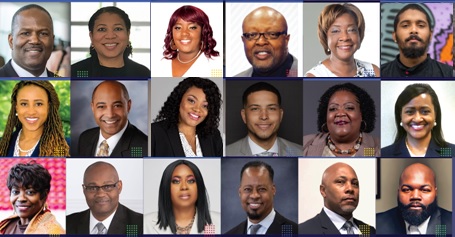
“This was the best and most informative business summit event that I have ever been part of,” said Chef Wilson Calixte, owner of Le Voltaire French Restaurant, one of Omaha’s top restaurants.
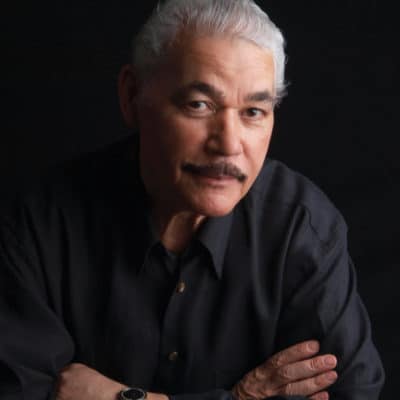
“What’s happening in Omaha is the prototype for the nation,” said George Fraser, CEO of FraserNet, the PowerNetworking Conference and member of the National Black Business Hall of Fame. “Join this local and national Network, keep building and stay the course.”
Fraser is known across the world as one of the top experts on building highly effective and productive networks.
He joined Dr. Pamela Jolly, a nationally recognized thought leader on wealth building and a strategic advisor for business accelerators, as keynote speakers for the virtual Revive Black Business Summit.
Both Jolly and Fraser, along with other nationally known Black business leaders and entrepreneurs, have agreed to join the Revive Black Business Network Board of Advisors and to extend special offers to its members.
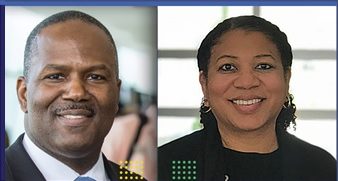
The Business Summit was hosted on Saturday, January 15th by Willie and Yolanda Barney, co owners of Revive Omaha!, Revive Center and Carver Legacy Center. 2022 marks 14 years since they launched Revive Magazine and 9 years since they formed the Revive Black Business Luncheon. January 15th also marked the 93rd birthday of Dr. Martin Luther King, Jr.
“We have talked for years about launching the formal Business Network, but put it on hold as we worked on other community projects and businesses,” said Willie Barney. “We believe now is the time to move forward and build on and expand our local and national partnerships. To launch the Business Network on Dr. King’s birthday is incredibly significant. 2022 will be a breakthrough year.”
Jolly kicked off the Summit with an insightful presentation on the State of Black Business, emerging opportunities on the national level and the importance of working together.
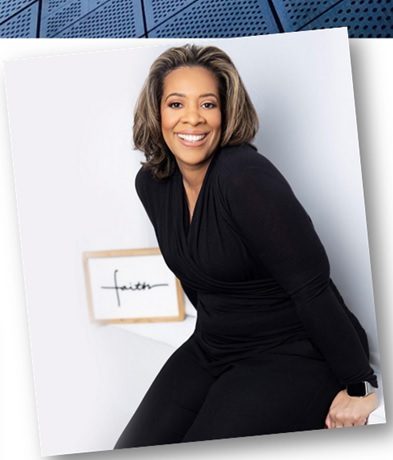
“My research shows the benefit of building wealth together and elevating the standard of how we do business,” said Jolly. “We need to be prepared for the current and future opportunities.”
If the response from attendees is any indicator, the Black Business Network is an idea whose time has come.
“The experience was absolutely amazing and very informative. It was like I stumbled upon a high-level business master class led by owners and subject matter experts that were so willing to share their personal best practices and success strategies,” said Tim Clark, CEO of Clark Connection Group.
Clark also delivered a powerful message of his own during a session on Effective Networking. “Be intentional. Be credible. Build trust. Listen. Listen. Listen.”
“The information presented was extremely valuable for business owners,” said Marcella Dial who attended along with her husband, Howard. “We got started with our business, but felt stuck. This event helped us to see ways to move forward.”
The Summit featured some of Omaha’s most successful Black business owners and entrepreneurs.
Carmen Tapio, CEO of North End Teleservices, has grown from 0 to 400 employees in just over five years. She shared her journey and how she overcame initial rejections from banks to secure the funding she needed to expand. Tapio said she is aiming to create jobs for 1,000+ and continue changing lives through her business. She also encouraged attendees not to give up.
Candice Price, a serial entrepreneur including co-ownership of Home Team Auto Sales and Sapphire Grill, offered insights on generating multiple streams of income and highlighted the services available through the new non-profit she leads, Grow Nebraska. “Having multiple streams of income was a blessing for us during the pandemic as we had to put our food truck in storage.”
Richard Webb, probably best known as the former CEO of the 100 Black Men and current CEO of the Boys and Girls Clubs of the Midlands, shared his experiences as a successful business owner and real estate investor with his firm, Abundant Living. “You don’t have to spend thousands of dollars attending seminars, it is possible to make money by investing in real estate. Develop relationships.”
Gladys Harrison, owner of Big Mama’s Kitchen and Catering, spoke about being innovative and reinventing your business in the midst of challenges. With most Black businesses struggling and 41% closing during the pandemic, Gladys reported that 2020 was their best financial year in the history of the company as they expanded on partnerships. “It was the partnerships that allowed us to grow when others were closing down.”
Calvin Jones, CEO of Lions Gate Security, shared some best practices for establishing relationships and doing business with corporations and public entities, including some of Omaha’s largest organizations. “Persistence. You can’t be afraid to knock on the door and keep knocking.”
“What I experienced at the Summit was powerful, educational and dynamic,” said Bridget Hadley, Economic Development Manager for the City of Omaha. “The depth of experience among all of the panelists makes Omaha and our community rich. The exchange of information and nuggets of wisdom shared were practical, yet invaluable, and ready for implementation.”
“It was incredibly inspiring to hear from these successful business owners,” said Yolanda Barney. “Being in business, especially during a time like this, can be challenging and you can feel isolated. This let’s you know that you can still move forward and staying connected is vitally important.”
That is one of the main goals for formalizing the Revive Black Business Network. The group keeps businesses connected, shares information about resources and opportunities, identifies funding sources and provides a platform to communicate successes and best practices.
In addition to business owners and entrepreneurs, the speakers and panelists on the summit included a wide range of service providers and support organizations available to assist with information, access to credit and capital, training and technical assistance.
BC Clark – Nebraska Enterprise Fund, Candice Price – Grow Nebraska, Manne Cook – Spark Capital, Bridget Hadley – City of Omaha, and Ernest White – Carver Legacy Center all highlighted different forms of funding including grants, loans, TIF and equity. All of the organizations also offer training and special events. Karine Sokpah, founder of the Midlands African Chamber also highlight opportunities for entrepreneurs to win $10,000 through the Pitch Black competition.
“When we started the Revive Black Business Network, we wanted to make sure business owners and entrepreneurs knew what resources and opportunities were available to them,” said Willie Barney. “We have updated the Roadmap to Entrepreneurship in Omaha and we will have a consistent location for these activities to happen at the HUB inside the Carver Legacy Center and also at the Revive Center Markets.”
Two other sessions focused on helping businesses to get prepared with a solid foundation. Malinda Williams, financial advisor with MVEST Partners shared tips for getting personal and business balance sheets in order.
Martine Quartey, owner of Advance Tax Solutions with 20+ years of experience, walked participants through key aspects needed to manage taxes professionally. “Too many business don’t handle their taxes correctly, but we can help them build a solid foundation.”
Dr. Martin Williams of Martin Williams International and DreamKeepers focused on existing business owners and presented key concepts he has used over the years to help businesses scale. “Creating successful businesses is about culture.”
The final session included specific opportunities to do business with corporations and public entities. Winsley Durand from the Greater Omaha Chamber/REACH, Gerald Kuhn from the City of Omaha and Cameron Gales of Jacobs Construction all provided valuable contacts and pathways to get in the door. James Wright from Congressman Don Bacon’s office also discussed ways the office could be helpful.
“I thought the meeting was excellence in motion. So much good information and resources within our own community,” said Sophia Jordan, owner of Black Bottom Biscotti. “I am inspired to keep going and do business on purpose within our own community even more so.”
Fraser who closed the day off with a powerful keynote and an extended “post conference” session, emphasized some final key points.
“We can create jobs, build our communities and prepare the next generation,” said Fraser. “If you do not have a system, you do not have a business. What is your system? What is your promise?”
He added, “We must connect, grow and prosper so we can learn, earn and return. Omaha has the opportunity to show the way.”
It was the perfect ending to the Summit. Creating moments like this on a consistent basis is one of the main goals for the Business Network.
“When do you ever have an opportunity to have George Fraser, a living legend, on a live zoom for an hour personally answering questions and sharing his experiences and insights?” said Calvin Jones.
The Revive Black Business Network will host meetings, summits, workshops, luncheons, conferences, expos and other events throughout the year.
The Black Business Summit was hosted by Revive! Omaha, Revive Center and Carver Legacy Center. The virtual event was managed by RealQuick Solutions.



NEWS
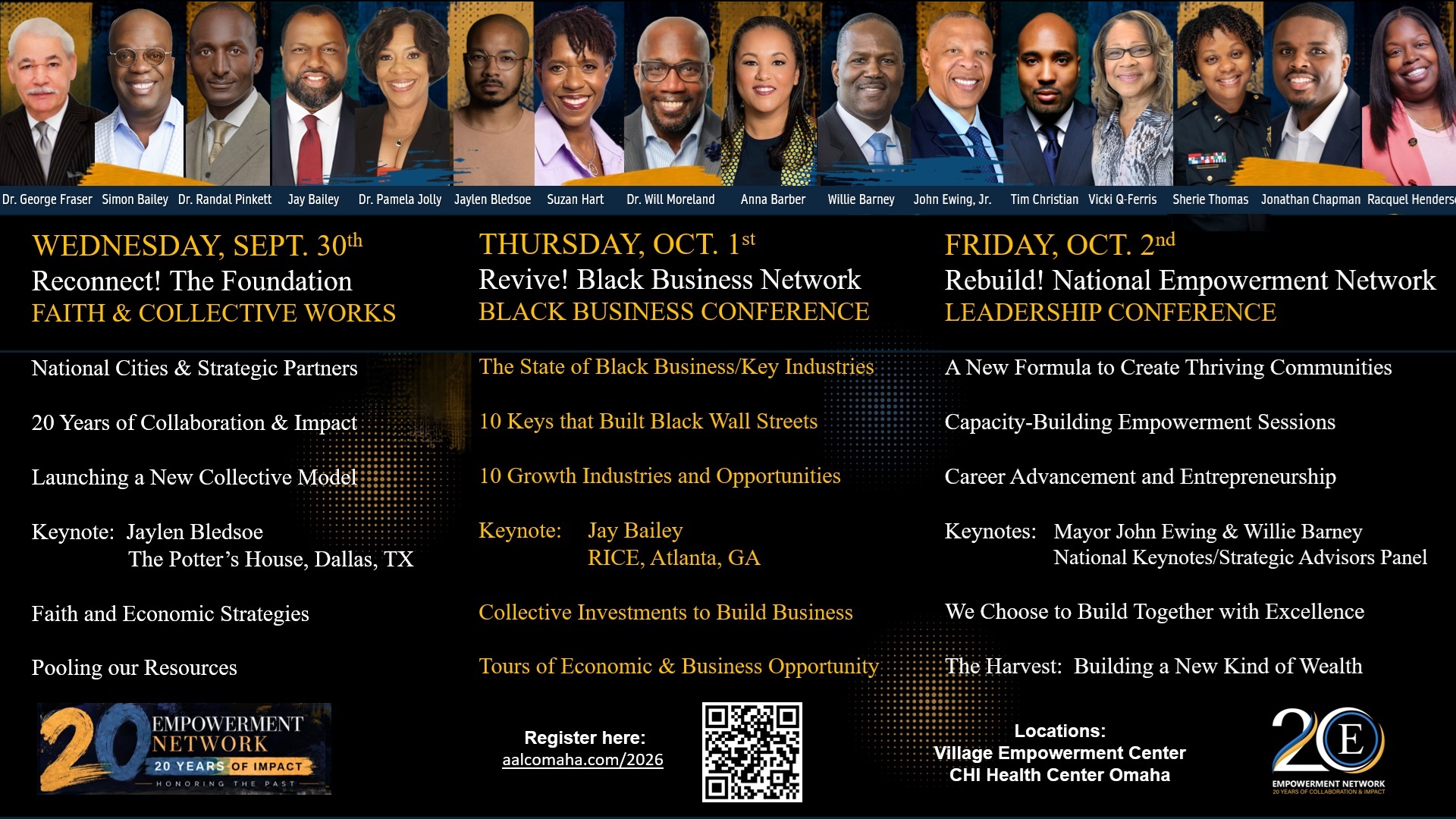
20th Anniversary Leadership Conference; career advancement, entrepreneurship & community impact
Community Features
Thinking Big & Bold; $14 Million Development in North Omaha

By Co-Publisher, Willie D. Barney, July 2026
How a 12-year vision, bold partners, and persistence helped bring a $14 million job creation project to North Omaha.
A quick story about thinking big and bold. I realized this week that I never shared this behind-the-scenes piece I wrote a few months ago, when OEDC and CHI formally announced a $14 million job creation project that will bring 100 jobs to North Omaha. For me, this project is more than a building, more than a headline, and more than a ribbon cutting. It is a reminder of what can happen when we cast a vision, stay persistent, and believe that our community deserves solutions at scale.
North Omaha has always had talent, faith, creativity, entrepreneurs, families, leaders, and people ready to work. What we have not always had is the level of investment, access, and opportunity needed to match that talent. That is why this announcement matters. It shows what is possible when institutions listen, community leaders push, and partners are bold enough to stay at the table even when the work gets hard.

The Question That Opened the Door
Twelve years ago, I was in a meeting with Ann Schumacher, Pete Festersen, and Kevin Nokels, former vice president at CHI Health. We were discussing partnerships between the Empowerment Network and CHI Health to address needs in the community. Most of the conversation focused on health, which was important and needed. But I kept coming back to another part of community health: jobs, careers, and wages.
We talked initially about Step-Up and filling existing positions. Then Kevin leaned over and said something that stuck with me: “Why don’t you ask us to do something really BIG?”
WOW. I loved it. We were in the early days of creating the Transformation 2025 plan, and we were talking about taking solutions to scale. Kevin opened the door to do exactly that.
From an Idea to a Community Vision
After taking some time to think and pray about it, I called Kevin and said, “What if CHI could help with job creation by bringing one of their business units to North Omaha? What if that move could help address unemployment and create opportunities for entrepreneurs to do business?”
Kevin said, “Now you are talking.”
That was the beginning of a long journey. I asked Vicki Quaites-Ferris, our VP of Operations, to join me, and we started meeting with Kevin and members of his team to figure out ways to make it happen. As the idea gained momentum, we knew we needed a developer. I reached out to Michael Maroney because we had been working together for years on other initiatives. Michael joined in and made a commitment for OEDC to use its expertise and experience to help bring the vision to reality.
The Long Road to Fruition
We went through all kinds of plans, strategies, designs, and proposals. We looked at dozens of locations and buildings throughout North Omaha. We had one in the historic 24th and Lake area that was almost there, but we could not get it across the finish line. We looked at North 30th, Ames, 16th Street, and other locations.
There were barriers. Challenges. Changes in leadership. Then the pandemic hit, causing even more delays. If you have ever been part of real community development work, you know it rarely moves in a straight line. It takes vision, patience, faith, relationships, and a lot of people who refuse to give up.
Through it all, Michael Maroney and Pete Festersen kept pushing forward. I have not been as involved the last four years, other than working with State Senators to help get state funds approved through LB531. But Michael, Pete, OEDC staff, CHI leaders, elected officials, funders, and many others stayed with it and finally brought it to fruition.

A Win Bigger Than One Project
Now, North Omaha will see a $14 million project that is expected to generate more than 100 jobs with competitive wages and benefits. It will also double CHI’s capacity to serve meals across the region. That is impact. That is investment. That is what happens when a community-centered idea is given room to grow into something transformational.
I think it is important to say this plainly: Black communities deserve more than programs that manage poverty. We deserve investments that create ownership, jobs, careers, contracts, business opportunities, and generational impact. We deserve partners who do not just come to the community for meetings, but who are willing to bring real projects, real dollars, and real opportunity.
The Lesson: Ask Big, Stay Bold
This project reminds me why we have to keep thinking big. Sometimes the first idea is not big enough. Sometimes the first location does not work. Sometimes the timeline stretches far beyond what we expected. But when the vision is rooted in community and the partners remain committed, the outcome can still be powerful.
I am incredibly encouraged to see what is possible when we think big, cast a bold vision, and work with partners who are willing to stick with it even when it gets hard. Congratulations to OEDC and CHI Health. This is a big win for North Omaha, for the city, and for the region.
NEWS
Rebuilding the Village Conference Brings Local, National Leaders to Omaha

OMAHA, Neb. (May 15, 2026) — The Empowerment Network convened local, national and international leaders May 6-8 in Omaha for the 19th annual Rebuilding the Village Conference, a three-day gathering focused on collaboration, economic opportunity and community transformation.
“For nearly two decades, Rebuilding the Village has been a place where people come together to share what is working, learn from one another and strengthen the relationships needed to move communities forward,” said Willie Barney, CEO & Founder, Empowerment Network.

The conference brought together community leaders, entrepreneurs, educators, policymakers, advocates and residents for keynote conversations, breakout sessions and strategy discussions focused on safer neighborhoods, stronger families, entrepreneurship, education, housing, reentry, violence prevention and Transformation 2030.
The conference concluded Friday, May 8, at the Hilton Omaha Downtown with the Rebuilding the Village Conference and Luncheon. The day’s theme, “Intentional Collaboration: Working Together to Create Places Where We Can All Win,” guided conversations on measurable, community-led progress.
 “For nearly two decades, Rebuilding the Village has been a place where people come together to share what is working, learn from one another and strengthen the relationships needed to move communities forward,” said Willie Barney, CEO and founder of the Empowerment Network. “This year was especially important as we advanced Transformation 2030 and focused on the next level of intentional collaboration.”
Transformation 2030 builds on the Empowerment Network’s work in North Omaha and partner cities, with goals tied to education, employment, housing, entrepreneurship, health, public safety, civic engagement and community development. The initiative includes goals of 100% of students reading on grade level, a 90%-plus high school graduation rate, 2,000 families connected to higher-wage jobs, 250 businesses launched or scaled with employees, 2,500 housing units developed, 60% homeownership in North Omaha and a 50% reduction in gun violence and incarceration.


Photo: Thelma French, CEO of Total Community Action, New Orleans
The conference featured speakers and representatives from Omaha and other cities, including Cleveland, Durham, North Carolina; Kansas City, Missouri; Lansing, Michigan; Minneapolis; New Orleans; St. Louis; Syracuse, New York; and Tulsa, Oklahoma. Sessions highlighted strategies in education, housing, business growth, workforce development, violence prevention, cultural tourism, health access, fund development, neighborhood revitalization and communications.

Breakout sessions focused on reaching education goals, creating housing through innovation and collaboration, doubling the number of Black-owned businesses with employees, connecting residents to higher-wage careers, reducing violence while decreasing arrests and juvenile detention, expanding cultural tourism and improving access to quality health care.
“Rebuilding the Village continues to be a powerful platform for bringing people together around what works,” said Jonathan Chapman, vice president of community collaboratives for the Empowerment Network. “The value is in the relationships, the shared learning and the commitment to take practical strategies back into neighborhoods, organizations and cities.”

The luncheon keynote panel focused on the national and global expansion of intentional collaboration through Empowerment Network 360, Village Strategies and Business Exchanges. National leaders shared lessons from their local work and discussed how coordinated, community-driven strategies can strengthen neighborhoods and expand opportunity.
The Rebuilding the Village Conference also served as a platform for advancing the Empowerment Network’s broader mission of connecting people and partners, communicating solutions and collaborating to address community issues. Since 2006, more than 10,000 residents and hundreds of partners have worked through the Network to support progress in jobs, safety, education, housing and health.

“Events like Rebuilding the Village are so important because they showcase Black talent locally and nationally in a way people don’t always get to see,” said Sheri Moore, Rebuilding the Village vendor and founder, Valincia’s Daughter. “They also create space for Black entrepreneurs who may not always have a place to sell their products and connect with the community.”
Rebuilding the Village is supported by sponsors like American National Bank/Associated Bank, Carver Legacy Center, CHI Health, the Nebraska Department of Economic Development and PPRP Innovations, along with partners including The Charles E. Lakin Foundation, the Obama Foundation’s My Brother’s Keeper Alliance (MBK), Revive and Weitz Family Foundation.
As a My Brother’s Keeper Model Community, MBK Omaha and the Empowerment Network are working with partners to build safer communities and connect more young people to opportunity. MBK Omaha was selected as a Model Community for demonstrating population-level impact in Milestone 6, focused on keeping youth safe from violent crime and providing second chances.
In alignment with the purpose of the My Brother’s Keeper Alliance, this year’s conference includes sessions focused on driving change, investing in the community, supporting students and helping them identify their strengths, gifts and talents.
To learn more about the Rebuilding the Village Conference, visit empoweromaha.com


