
NEWS
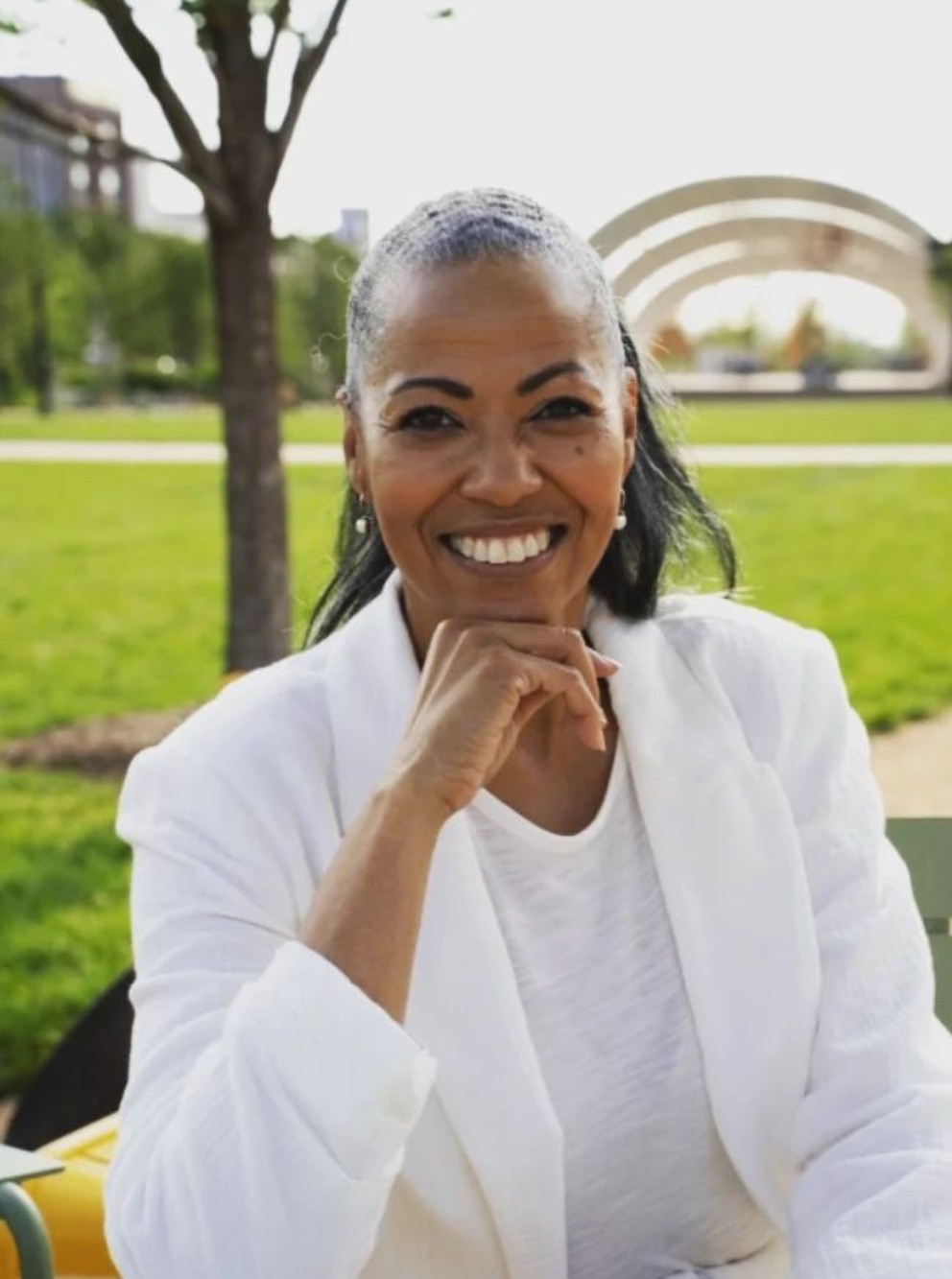
Veta Jeffery to speak at Omaha Conference featuring Magic Johnson and 20+ cities


NEWS
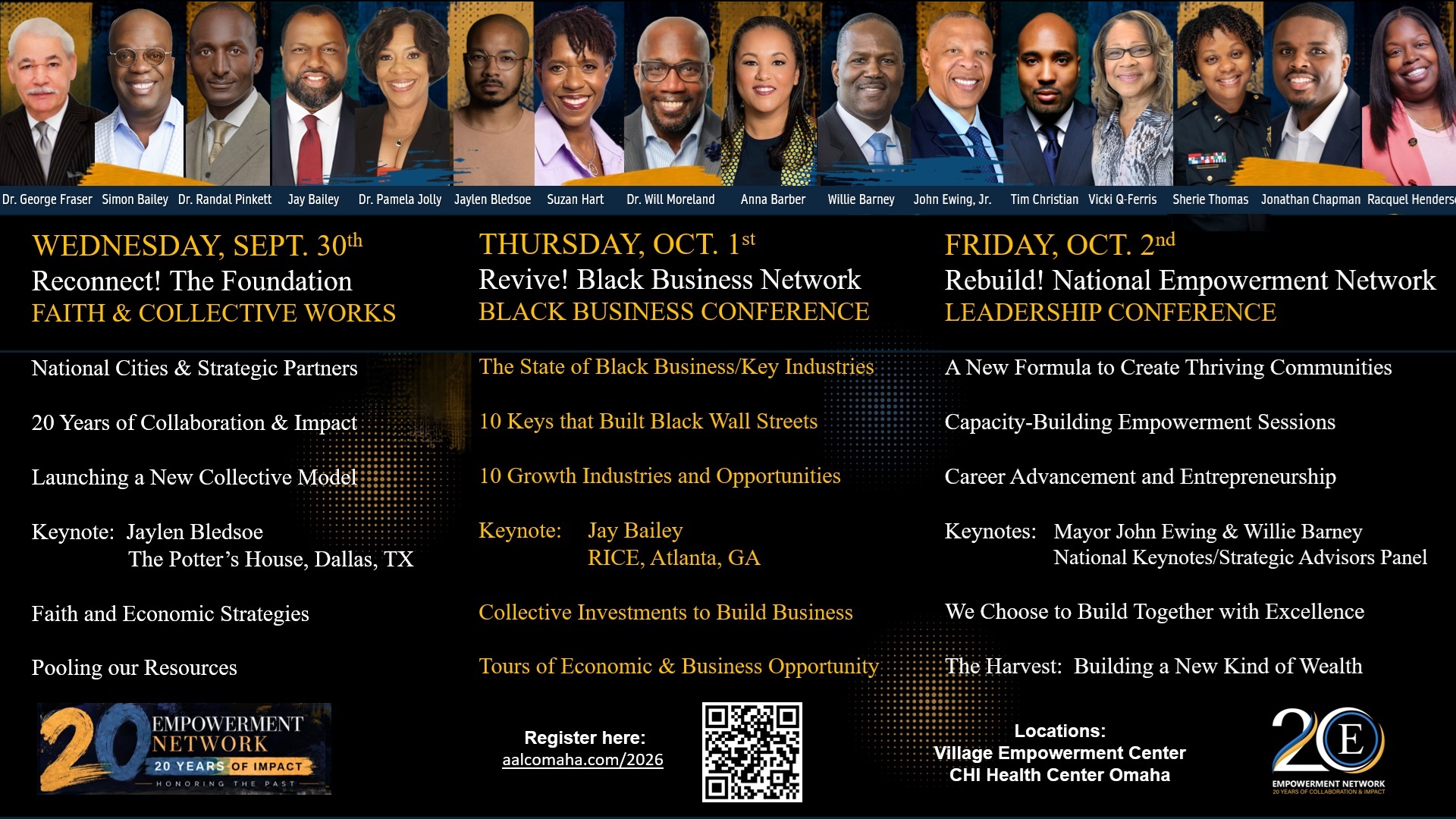
20th Anniversary Leadership Conference; career advancement, entrepreneurship & community impact
Community Features
Thinking Big & Bold; $14 Million Development in North Omaha

By Co-Publisher, Willie D. Barney, July 2026
How a 12-year vision, bold partners, and persistence helped bring a $14 million job creation project to North Omaha.
A quick story about thinking big and bold. I realized this week that I never shared this behind-the-scenes piece I wrote a few months ago, when OEDC and CHI formally announced a $14 million job creation project that will bring 100 jobs to North Omaha. For me, this project is more than a building, more than a headline, and more than a ribbon cutting. It is a reminder of what can happen when we cast a vision, stay persistent, and believe that our community deserves solutions at scale.
North Omaha has always had talent, faith, creativity, entrepreneurs, families, leaders, and people ready to work. What we have not always had is the level of investment, access, and opportunity needed to match that talent. That is why this announcement matters. It shows what is possible when institutions listen, community leaders push, and partners are bold enough to stay at the table even when the work gets hard.

The Question That Opened the Door
Twelve years ago, I was in a meeting with Ann Schumacher, Pete Festersen, and Kevin Nokels, former vice president at CHI Health. We were discussing partnerships between the Empowerment Network and CHI Health to address needs in the community. Most of the conversation focused on health, which was important and needed. But I kept coming back to another part of community health: jobs, careers, and wages.
We talked initially about Step-Up and filling existing positions. Then Kevin leaned over and said something that stuck with me: “Why don’t you ask us to do something really BIG?”
WOW. I loved it. We were in the early days of creating the Transformation 2025 plan, and we were talking about taking solutions to scale. Kevin opened the door to do exactly that.
From an Idea to a Community Vision
After taking some time to think and pray about it, I called Kevin and said, “What if CHI could help with job creation by bringing one of their business units to North Omaha? What if that move could help address unemployment and create opportunities for entrepreneurs to do business?”
Kevin said, “Now you are talking.”
That was the beginning of a long journey. I asked Vicki Quaites-Ferris, our VP of Operations, to join me, and we started meeting with Kevin and members of his team to figure out ways to make it happen. As the idea gained momentum, we knew we needed a developer. I reached out to Michael Maroney because we had been working together for years on other initiatives. Michael joined in and made a commitment for OEDC to use its expertise and experience to help bring the vision to reality.
The Long Road to Fruition
We went through all kinds of plans, strategies, designs, and proposals. We looked at dozens of locations and buildings throughout North Omaha. We had one in the historic 24th and Lake area that was almost there, but we could not get it across the finish line. We looked at North 30th, Ames, 16th Street, and other locations.
There were barriers. Challenges. Changes in leadership. Then the pandemic hit, causing even more delays. If you have ever been part of real community development work, you know it rarely moves in a straight line. It takes vision, patience, faith, relationships, and a lot of people who refuse to give up.
Through it all, Michael Maroney and Pete Festersen kept pushing forward. I have not been as involved the last four years, other than working with State Senators to help get state funds approved through LB531. But Michael, Pete, OEDC staff, CHI leaders, elected officials, funders, and many others stayed with it and finally brought it to fruition.

A Win Bigger Than One Project
Now, North Omaha will see a $14 million project that is expected to generate more than 100 jobs with competitive wages and benefits. It will also double CHI’s capacity to serve meals across the region. That is impact. That is investment. That is what happens when a community-centered idea is given room to grow into something transformational.
I think it is important to say this plainly: Black communities deserve more than programs that manage poverty. We deserve investments that create ownership, jobs, careers, contracts, business opportunities, and generational impact. We deserve partners who do not just come to the community for meetings, but who are willing to bring real projects, real dollars, and real opportunity.
The Lesson: Ask Big, Stay Bold
This project reminds me why we have to keep thinking big. Sometimes the first idea is not big enough. Sometimes the first location does not work. Sometimes the timeline stretches far beyond what we expected. But when the vision is rooted in community and the partners remain committed, the outcome can still be powerful.
I am incredibly encouraged to see what is possible when we think big, cast a bold vision, and work with partners who are willing to stick with it even when it gets hard. Congratulations to OEDC and CHI Health. This is a big win for North Omaha, for the city, and for the region.
NEWS
Rebuilding the Village Conference Brings Local, National Leaders to Omaha

OMAHA, Neb. (May 15, 2026) — The Empowerment Network convened local, national and international leaders May 6-8 in Omaha for the 19th annual Rebuilding the Village Conference, a three-day gathering focused on collaboration, economic opportunity and community transformation.
“For nearly two decades, Rebuilding the Village has been a place where people come together to share what is working, learn from one another and strengthen the relationships needed to move communities forward,” said Willie Barney, CEO & Founder, Empowerment Network.

The conference brought together community leaders, entrepreneurs, educators, policymakers, advocates and residents for keynote conversations, breakout sessions and strategy discussions focused on safer neighborhoods, stronger families, entrepreneurship, education, housing, reentry, violence prevention and Transformation 2030.
The conference concluded Friday, May 8, at the Hilton Omaha Downtown with the Rebuilding the Village Conference and Luncheon. The day’s theme, “Intentional Collaboration: Working Together to Create Places Where We Can All Win,” guided conversations on measurable, community-led progress.
 “For nearly two decades, Rebuilding the Village has been a place where people come together to share what is working, learn from one another and strengthen the relationships needed to move communities forward,” said Willie Barney, CEO and founder of the Empowerment Network. “This year was especially important as we advanced Transformation 2030 and focused on the next level of intentional collaboration.”
Transformation 2030 builds on the Empowerment Network’s work in North Omaha and partner cities, with goals tied to education, employment, housing, entrepreneurship, health, public safety, civic engagement and community development. The initiative includes goals of 100% of students reading on grade level, a 90%-plus high school graduation rate, 2,000 families connected to higher-wage jobs, 250 businesses launched or scaled with employees, 2,500 housing units developed, 60% homeownership in North Omaha and a 50% reduction in gun violence and incarceration.


Photo: Thelma French, CEO of Total Community Action, New Orleans
The conference featured speakers and representatives from Omaha and other cities, including Cleveland, Durham, North Carolina; Kansas City, Missouri; Lansing, Michigan; Minneapolis; New Orleans; St. Louis; Syracuse, New York; and Tulsa, Oklahoma. Sessions highlighted strategies in education, housing, business growth, workforce development, violence prevention, cultural tourism, health access, fund development, neighborhood revitalization and communications.

Breakout sessions focused on reaching education goals, creating housing through innovation and collaboration, doubling the number of Black-owned businesses with employees, connecting residents to higher-wage careers, reducing violence while decreasing arrests and juvenile detention, expanding cultural tourism and improving access to quality health care.
“Rebuilding the Village continues to be a powerful platform for bringing people together around what works,” said Jonathan Chapman, vice president of community collaboratives for the Empowerment Network. “The value is in the relationships, the shared learning and the commitment to take practical strategies back into neighborhoods, organizations and cities.”

The luncheon keynote panel focused on the national and global expansion of intentional collaboration through Empowerment Network 360, Village Strategies and Business Exchanges. National leaders shared lessons from their local work and discussed how coordinated, community-driven strategies can strengthen neighborhoods and expand opportunity.
The Rebuilding the Village Conference also served as a platform for advancing the Empowerment Network’s broader mission of connecting people and partners, communicating solutions and collaborating to address community issues. Since 2006, more than 10,000 residents and hundreds of partners have worked through the Network to support progress in jobs, safety, education, housing and health.

“Events like Rebuilding the Village are so important because they showcase Black talent locally and nationally in a way people don’t always get to see,” said Sheri Moore, Rebuilding the Village vendor and founder, Valincia’s Daughter. “They also create space for Black entrepreneurs who may not always have a place to sell their products and connect with the community.”
Rebuilding the Village is supported by sponsors like American National Bank/Associated Bank, Carver Legacy Center, CHI Health, the Nebraska Department of Economic Development and PPRP Innovations, along with partners including The Charles E. Lakin Foundation, the Obama Foundation’s My Brother’s Keeper Alliance (MBK), Revive and Weitz Family Foundation.
As a My Brother’s Keeper Model Community, MBK Omaha and the Empowerment Network are working with partners to build safer communities and connect more young people to opportunity. MBK Omaha was selected as a Model Community for demonstrating population-level impact in Milestone 6, focused on keeping youth safe from violent crime and providing second chances.
In alignment with the purpose of the My Brother’s Keeper Alliance, this year’s conference includes sessions focused on driving change, investing in the community, supporting students and helping them identify their strengths, gifts and talents.
To learn more about the Rebuilding the Village Conference, visit empoweromaha.com


